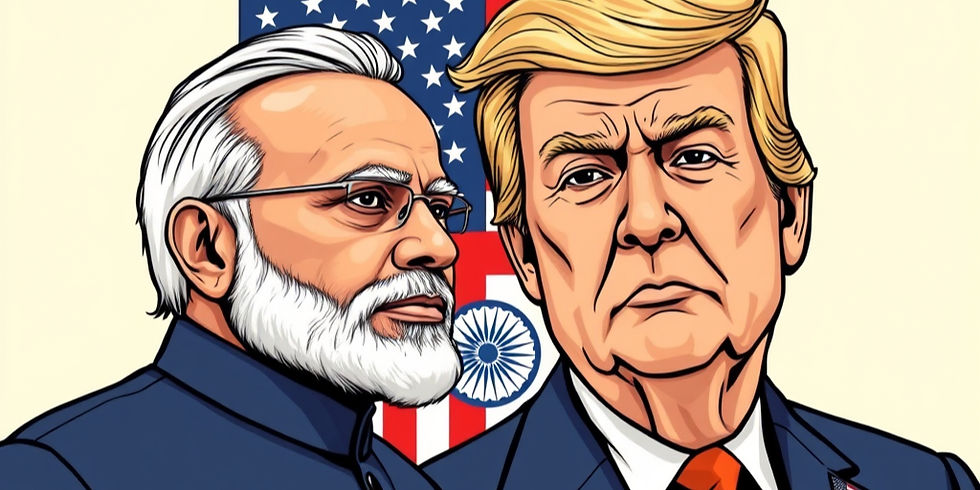
India - UK Free Trade Agreement: A New Opportunity for Startup and Emerging Fashion Brands

The global fashion industry is becoming interconnected more than ever. A clothing brand no longer needs to manufacture everything locally, operate a large factory or invest millions to build an international fashion business. Today, an emerging fashion label can develop its collections in one country, manufacture in another and sell to customers across several international markets.
However, one challenge has consistently affected smaller fashion businesses and that is the cost of international trade which essentially means tariffs. Import duties, customs procedures, sourcing costs and regulatory requirements can make international expansion difficult, particularly for independent designers, startup fashion labels and small businesses operating with limited budgets.

The India–United Kingdom Free Trade Agreement (FTA) is an important development in this context.
Officially known as the Comprehensive Economic and Trade Agreement (CETA), the agreement entered into force on 15 July 2026. It creates new opportunities for businesses in both countries by reducing trade barriers, improving market access and making cross-border trade more predictable.
For emerging UK fashion brands considering manufacturing in India, and Indian clothing manufacturers looking to work with international startups, this agreement could make an important commercial difference.
But what does it actually mean for a small fashion business? Can a startup benefit from manufacturing its clothing in India? Will importing garments from India become cheaper? And how can a new fashion label take advantage of these developments?
Let's understand the opportunities in detail.
What is the India–UK Free Trade Agreement?
A Free Trade Agreement is a trade arrangement between two or more countries that reduces or removes certain barriers to international trade.
These barriers commonly include:
Import and export duties.
Customs-related restrictions.
Regulatory and administrative procedures.
Certain limitations affecting cross-border services and investments.
The India–UK FTA aims to make trade between the two countries easier and more commercially attractive.
The agreement was signed in July 2025 and became operational on 15 July 2026.
Some of its important highlights include:
Area | What the agreement provides |
Indian exports to the UK | Duty-free access for almost 99% of Indian export tariff lines |
UK exports to India | Tariffs removed or reduced on approximately 90% of tariff lines |
Textiles and apparel | Significant opportunities through improved market access |
Small businesses | Dedicated provisions supporting SMEs |
Customs | Improved transparency and trade facilitation |
Digital trade | Greater cooperation on digital processes and transactions |
According to India's Ministry of Commerce and Industry, the agreement provides unprecedented duty-free access to almost 99% of India's exports to the UK, covering nearly 100% of the trade value.
This is particularly relevant to labour-intensive industries such as textiles, garments, footwear and leather products.
For fashion businesses, the most important takeaway is that eligible Indian-origin clothing products can now enter the UK market without the import duties that would otherwise apply under normal tariff arrangements.

Why is this agreement particularly important for the fashion industry?
Fashion is an international business by nature.
A typical fashion brand may have its design team in London, source fabrics from different countries, manufacture garments in India and sell finished products through its own website, retail partners and international marketplaces.
Every additional cost in this supply chain affects the final product price.
For an established fashion company, an additional import duty may be manageable. For a startup selling its first 500 or 1,000 garments, however, the same duty can significantly affect its profit margins.
India has a well-established textile and apparel manufacturing ecosystem, with capabilities across:
Cotton and woven garments.
Knitted clothing.
Denim and casualwear.
Women's fashion.
Children's clothing and infantwear.
Sustainable and organic clothing.
Private-label apparel.
Embroidery, printing and value-added garments.
The FTA creates an opportunity for British fashion entrepreneurs to explore Indian manufacturing with a potentially more favourable landed-cost structure.
For Indian manufacturers, it also creates an opportunity to build relationships with a wider range of British fashion businesses.
The agreement does not automatically make every product cheaper. Its actual impact depends on the product's customs classification, applicable tariff schedule, origin qualification and import arrangements.
Nevertheless, the direction is commercially significant.
How will UK fashion startups benefit from manufacturing in India?
Let's consider a practical situation.
Imagine a fashion entrepreneur in Manchester wants to launch a new women's clothing label.
The founder has designed a collection of dresses, shirts, trousers and coordinated sets. Rather than investing in manufacturing infrastructure in the UK, the founder decides to outsource production to India.
Historically, the business would have needed to consider manufacturing costs, international shipping, import duties, customs clearance and other landed costs.
With the FTA now in force, eligible Indian-origin garments can benefit from preferential tariff treatment when imported into the UK.
This can create several advantages.
Potential reduction in landed cost
Landed cost is the total cost of bringing a product from the manufacturer to the buyer's warehouse or fulfilment location.
It typically includes:
Garment manufacturing cost.
International freight.
Insurance, where applicable.
Customs duties.
Customs clearance and handling charges.
Other applicable import costs.
When customs duties are reduced or eliminated, the landed cost of eligible products can decrease.
For a startup fashion brand, this can provide three possible advantages:
Maintain the existing selling price and improve gross margins.
Offer more competitive prices without compromising product quality.
Reinvest the savings into marketing, product development and customer acquisition.
The actual saving will depend on the previous applicable duty rate and the product's eligibility under the agreement.
An important distinction: Customs duty savings do not automatically mean that GST, import VAT, freight, clearance charges or other taxes disappear. These must be considered separately.
Better access to Indian manufacturing capabilities
India offers a diverse manufacturing ecosystem that can support fashion brands at different stages of development.
A startup may initially require only a small collection of 5–10 designs. As the brand grows, it may need larger production runs, additional fabrics, new categories and more sophisticated manufacturing capabilities.
Working with an experienced Indian manufacturer can help a brand develop this manufacturing relationship over time.
For example, an emerging label could begin with:
25 pieces per style.
A limited collection of 5 designs.
A small seasonal launch.
A capsule collection.
A trial production run before expanding.
These quantities are examples of possible manufacturing arrangements, not benefits or minimum quantities guaranteed by the FTA.
The agreement does not regulate factory MOQs. Minimum order quantities remain a commercial decision between the manufacturer and the brand.
More room for product development
One of the biggest challenges for a startup fashion label is developing a commercially viable product before committing to bulk production.
A good manufacturing partner can assist with:
Pattern development.
Sampling and prototype development.
Fabric sourcing.
Garment construction.
Size grading.
Fit corrections.
Printing and embroidery.
Bulk manufacturing.
This becomes particularly valuable when a brand is developing its first collection and needs to test different silhouettes, fabrics and fits.
Instead of building an entire manufacturing operation, the founder can focus on designing, branding, selling and understanding the customer.
Greater opportunity to compete internationally
The UK fashion market has room for independent brands with distinctive products, clear positioning and well-developed identities.
An emerging brand does not necessarily need to compete with established retailers on volume.
It can compete through:
Distinctive designs.
Better product construction.
Carefully selected fabrics.
Responsible sourcing.
Limited collections.
Strong brand storytelling.
A clearly defined customer segment.
More favourable trade conditions can support this business model by improving the economics of international sourcing.
Why small batch clothing manufacturers will become increasingly important
The traditional clothing manufacturing model was largely designed around volume.
Manufacturers preferred large orders because bigger production runs made it easier to distribute setup costs, labour and overheads across more garments.
However, the business model of modern fashion startups is different.
An emerging fashion label may not know which design will sell, which colour will perform best or which size will generate the most demand.
Producing 2,000 pieces of an untested design can create a substantial inventory risk.
This is why Small Batch Clothing Manufacturers are becoming increasingly relevant to independent fashion labels.
Small-batch manufacturing allows brands to develop products and manufacture limited quantities without immediately committing to large production volumes.
What is small-batch clothing manufacturing?
Small-batch clothing manufacturing refers to producing garments in relatively limited quantities compared with traditional mass production.
For example:
Manufacturing approach | Illustrative quantity |
Prototype/sample development | 1–5 pieces |
Very small production | 25–50 pieces |
Small-batch collection | 50–150 pieces |
Growing fashion brand | 150–500 pieces |
Established production | 500+ pieces |
These are illustrative commercial categories, not fixed industry definitions. Actual MOQs vary depending on the manufacturer, garment type, fabric, colour, printing and embellishment requirements.
The FTA connection
The India–UK FTA does not specifically offer lower MOQs or special tariff benefits for small orders.
However, by potentially reducing import duties on qualifying Indian-origin products, it improves the commercial environment in which small-batch manufacturing can operate.
This is an important distinction.
The FTA improves the trade framework. A capable small-batch manufacturer provides the production flexibility.
Together, these factors can make India a more attractive manufacturing destination for emerging British fashion labels.
Clothing Manufacturer for Small Business: Why choosing the right partner matters
Finding a Clothing Manufacturer for Small Business is not simply about finding a factory that accepts fewer pieces.
The right manufacturing partner should understand the operational and financial realities of a startup.
A new fashion label generally needs more than sewing capacity. It needs a partner who can understand its designs, develop samples, identify suitable fabrics and help convert creative concepts into production-ready garments.
Here are some important factors to evaluate.
1. Minimum order quantity
MOQ is one of the first questions a startup should ask.
Some manufacturers accept smaller quantities for basic garments but require substantially larger orders for printed, embroidered or specially developed fabrics.
Ask for a clear MOQ structure before beginning development.
2. Sampling capabilities
A manufacturer should be able to develop samples based on the brand's technical specifications, reference garments, sketches or tech packs.
Sampling is particularly important for emerging brands because the first prototype is rarely the final product.
3. Fabric sourcing
Fabric availability can significantly affect product cost, minimum order quantities and production timelines.
4. Quality control
A low manufacturing price has little value if the finished garments do not meet the brand's quality expectations.
Evaluate the manufacturer's approach to:
Fabric inspection.
Measurement checks.
Stitching quality.
Seam strength.
Colour consistency.
Shrinkage testing.
Final garment inspection.
5. Communication and transparency
International manufacturing involves multiple stages and decisions.
A reliable partner should communicate clearly about pricing, development timelines, material availability, production capacity and any potential delays.
This becomes especially important when the founder and manufacturing team are located in different countries.
6. Experience with international brands
Manufacturing for an international fashion label requires an understanding of export documentation, product specifications, packaging requirements and international quality expectations.
A manufacturer experienced in private-label apparel production can help reduce the learning curve for a first-time fashion entrepreneur.
This is one of the most important aspects of the India–UK FTA, and businesses should understand it before placing an order.
Not every garment shipped from India automatically qualifies for duty-free entry into the UK.
To claim preferential tariff treatment, products must satisfy the agreement's Rules of Origin.
These rules establish whether a product genuinely originates in India or the UK.
There are three broad ways goods may qualify:
They are wholly obtained or produced in India or the UK.
They are made entirely from qualifying originating materials.
They use non-originating materials but satisfy the applicable product-specific rules of origin.
For clothing manufacturers and fashion brands, the third category is particularly important.
For example, consider a British fashion brand that sources fabric from another country and sends it to India for garment manufacturing.
Can the finished garment qualify as Indian-origin?
The answer depends on the applicable product-specific rule for that garment's customs classification and the manufacturing processes carried out.
Simply shipping an imported finished garment through India, relabelling it or repacking it does not make it Indian-origin.
Similarly, the fact that a garment is stitched in India does not, by itself, establish eligibility in every case. The applicable product-specific rule must be checked.
What should fashion brands do?
Before starting production, brands should:
Identify the correct HS code for each product.
Check the relevant product-specific rule of origin.
Understand which fabrics and components can be imported.
Maintain fabric purchase records.
Maintain production and manufacturing records.
Keep supplier invoices and supporting documents.
Confirm the origin documentation required for the shipment.
This is especially important for brands developing garments using imported fabrics, specialised trims and accessories.
The agreement's Chapter 3 and Annex 3A contain the relevant rules.
What does the FTA mean for Indian clothing manufacturers?
The agreement is not only beneficial for British fashion startups.
It also creates opportunities for Indian manufacturers, particularly those specialising in private-label apparel and made-to-order production.
Historically, many Indian manufacturers have depended on established international brands and larger buyers.
However, the global fashion industry is witnessing the growth of independent labels, direct-to-consumer businesses and niche fashion companies.
These businesses often require a different manufacturing approach.
They may need:
Smaller production quantities.
Multiple styles in one order.
Flexible development arrangements.
Custom fabric sourcing.
Private-label manufacturing.
Consistent communication.
Reliable quality control.
Indian manufacturers that understand these requirements can position themselves to work with a broader international customer base.
The opportunity is particularly relevant for manufacturers that can combine product development, sourcing, sampling and bulk production under one coordinated process.
Why manufacturers should prepare now
Manufacturers interested in attracting UK-based startups should consider:
Developing clear MOQ policies.
Creating transparent sampling and production processes.
Improving product documentation.
Maintaining traceability of fabrics and components.
Understanding UK customs and origin requirements.
Offering consistent quality-control procedures.
Building digital communication and order-management systems.
The FTA may reduce certain trade costs, but it does not eliminate the need for good manufacturing practices.
In fact, as international sourcing becomes more commercially attractive, product quality and
operational reliability will become even more important.

Is India becoming a more attractive manufacturing destination for UK fashion brands?
India already has a significant position in the global textile and apparel supply chain.
Its manufacturing capabilities, availability of different fabric categories, skilled workforce and established export ecosystem make it an important sourcing destination.
The FTA adds another commercial consideration to this existing manufacturing proposition.
For a UK fashion startup, the decision to manufacture in India should be based on a combination of factors:
Evaluation factor | Why it matters |
Manufacturing cost | Determines product economics |
MOQ flexibility | Helps manage inventory risk |
Fabric availability | Affects design and sourcing decisions |
Product quality | Influences customer satisfaction |
Sampling capabilities | Helps develop the collection |
Production lead time | Impacts launch schedules |
FTA eligibility | Can influence customs duty |
Export experience | Helps manage international shipments |
It is important not to assume that India will always be cheaper than every other manufacturing destination.
The final decision should compare the complete landed cost, product quality, lead time and reliability of the manufacturing partner. The FTA improves India's competitive position, but the manufacturer's capabilities remain equally important.
Frequently asked questions (FAQs)
1. What is the India–UK Free Trade Agreement?
The India–UK Free Trade Agreement, officially known as the Comprehensive Economic and Trade Agreement (CETA), is a bilateral trade agreement that entered into force on 15 July 2026. It reduces or eliminates tariffs on qualifying goods and improves trade facilitation between the two countries.
2. Can UK fashion startups manufacture clothing in India and import it duty-free?
Yes, qualifying Indian-origin clothing products can benefit from preferential duty-free access to the UK. However, products must meet the applicable Rules of Origin and customs documentation requirements.
3. Will the India–UK FTA reduce clothing manufacturing costs?
It can reduce the overall landed cost of eligible imported garments by eliminating applicable customs duties. However, manufacturing prices, freight, import VAT, customs charges and other expenses remain separate considerations.
4. Are small-batch clothing manufacturers included in the FTA?
The FTA does not establish separate provisions for small-batch manufacturers. However, emerging brands using small-batch manufacturers can potentially benefit from preferential tariffs if their products qualify under the agreement.
5. What is the minimum order quantity for small fashion brands manufacturing in India?
MOQs vary by manufacturer, garment category, fabric and production requirements. Some manufacturers accept orders starting from 25 pieces per style for suitable products, while specialised printing, embroidery and custom fabrics may require higher quantities.
6. Does clothing manufactured in India automatically qualify for zero import duty in the UK?
No. The garment must meet the relevant product-specific Rules of Origin. Manufacturing location alone is not sufficient to establish preferential origin in every situation.
7. Which clothing categories can benefit from the India–UK FTA?
Qualifying knitted garments, woven garments and other eligible textile products can benefit. The precise tariff treatment depends on the applicable HS code and product-specific origin rules.
8. How can a startup find a clothing manufacturer in India?
Startups should evaluate manufacturers based on MOQ, sampling capabilities, fabric sourcing, quality control, export experience, communication and production flexibility. A manufacturer experienced in private-label and made-to-order apparel can be particularly useful.
9. Is India a good manufacturing destination for emerging UK fashion brands?
India offers an established apparel manufacturing ecosystem, diverse fabric options and capabilities across several clothing categories. The FTA adds a potential customs-duty advantage for qualifying products, making India worth considering when evaluating international manufacturing options.